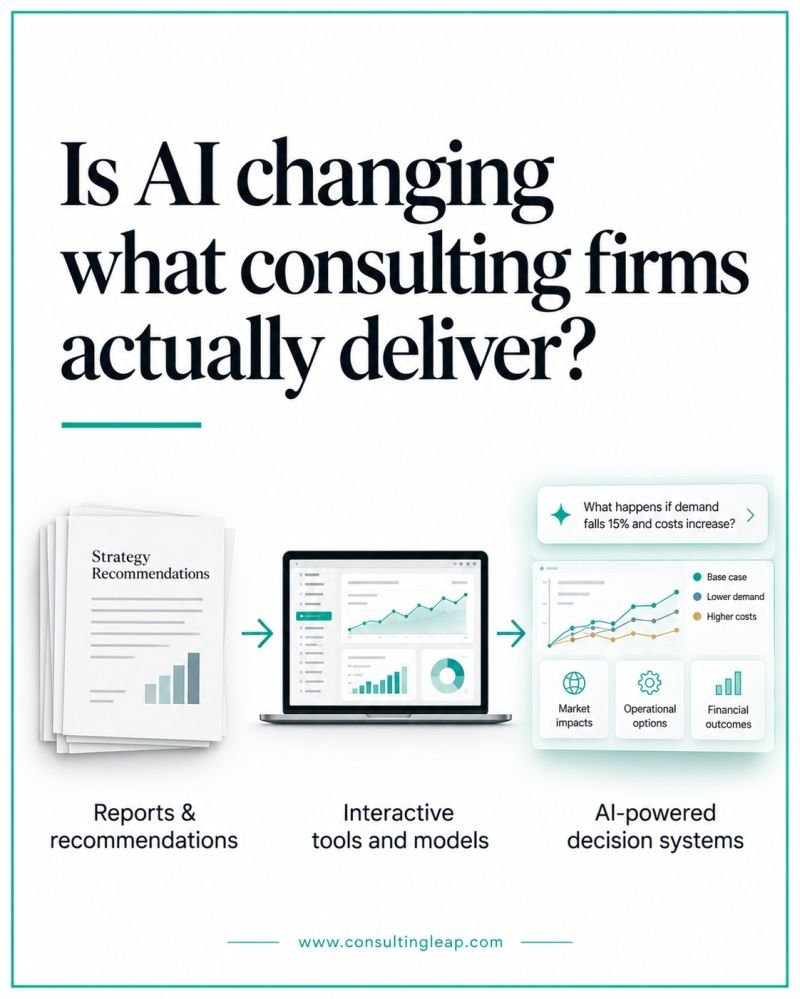
I’ve been looking into how AI might change what consulting firms actually deliver to clients. Here’s what I’ve found so far.
Some firms are using AI to interpret customer signals, evaluate business decisions and automate research that previously required considerable analyst involvement.
I came across three examples. These are mainly claims made by the firms themselves. I haven’t established whether they improved client outcomes, but I thought they were worth sharing.
1. BCG + Allstate: Spotting problems before they happen
Allstate already had predictive models for customer service issues. BCG X added GenAI to interpret customer conversations and changes in sentiment.
BCG reports that the enhanced model performed 3x better than previous models and identified potential customer problems before they occurred in 71% of cases.
Rather than just recommending improvements, the consultants helped build a system that tells employees when a customer may need attention.
2. KPMG: Helping executives evaluate tariff decisions
In May 2025, KPMG introduced an AI-powered Tariff Modeler that combines tariff policies, trade data and company information to assess sourcing options and their impact on margins.
What happens if tariffs rise on a key component? Which alternative suppliers should a company consider?
KPMG says more than 100 Fortune 500 and major private equity clients were implementing it. It also claims substantial savings, which I haven’t independently verified.
3. FifthRow: Automating strategic research
FifthRow, a smaller strategy and intelligence firm, says it built 18 AI-powered research systems for a US insurance carrier, supported by 347 reusable templates.
The systems investigate competitors, markets, product opportunities and potential acquisitions. FifthRow reports producing 3,278 studies over 20 months.
Of course, predictive models, scenario-planning tools and market monitoring aren’t new. Consulting firms have used them for years.
What’s changing is how AI can extend these capabilities, from making sense of unstructured information to supporting ongoing decisions.
Whether that produces better business outcomes is a separate question.
But I do think this opens up substantial opportunities for boutique consulting firms: new advisory services, deeper client engagements and potentially recurring revenue.
It also raises a question founders should be asking now:
Are our current offerings aligned with what clients need and what’s becoming possible with AI?
Because the opportunity isn’t just to deliver the same work faster. It’s to rethink what we’re actually delivering.
I’m curious what other consulting founders are seeing.
—
Ready to add $100k-$500k revenue to your consulting business in 12 months or less without burning out? Schedule a call and let me show you how.